
Prednisone changed everything. So why did no one tell us about it?
What this medication is doing for Graffiti right now, and what every HSA family deserves to know sooner

On the night of March 8th, I was watching Graffiti sleep and I counted his breaths.
One hundred and thirty-five in a minute. Then 130. Then, almost two hours later, 79. Then 62. Then 61.
I have been tracking his breathing for months at this point. I know what his numbers look like when he is settled and comfortable, and I know what it looks like when something is wrong. That night, the numbers at 5:50pm told me something was wrong. The numbers at 7:55pm told me whatever it was had passed.
I want to walk through what happened that night. And I want to write about the medication we started on March 3rd, because I believe every family navigating hemangiosarcoma deserves to understand what it does, why it matters, and why the conversation about it should happen earlier than it did for us.
That medication is prednisone.
What happened on March 8th
The breathing readings that night went like this:
5:50pm: 135 breaths per minute
6:23pm: 130 breaths per minute
6:50pm: 79 breaths per minute
7:01pm: 62 breaths per minute
7:55pm: 61 breaths per minute
Normal resting and sleeping breathing rates for dogs are generally between 15 and 30 breaths per minute. At 135, Graffiti was breathing at nearly five times that rate while asleep. I have never seen him that elevated. And while I do not want to manufacture drama around a number that, in the end, resolved on its own, I also do not want to minimize what it felt like to sit in that room, to count and wait.
What made that night particularly hard was that the elevated breathing did not come out of nowhere. Earlier in the afternoon, around 3pm, I had noticed his breathing was faster than normal while he was resting. I gave him his Yunnan Baiyao red pill early, because that is what you do when you are being proactive: you reach for the tools you have. I gave him his hydrocodone/acetaminophen, in case discomfort was what was driving it. And then, two and a half hours later, the rate was 135. That is the moment when fear compounds. You have already done the things you are supposed to do, and the numbers are still climbing.
Was this a bigger bleed? Was the Yunnan Baiyao not enough?
With hemangiosarcoma, you often cannot know in the moment. That is one of the hardest truths of this disease. Many professionals will tell you to bring a dog showing dramatic breathing changes to the ER, and in many circumstances, especially earlier in a diagnosis, that is exactly right. For Graffiti, at this stage of his journey, we are no longer going that route. We are in the care of a hospice team, and our goal is to support his comfort at home. That context shapes everything about how we navigate moments like this one.
Elevated breathing in an HSA dog can mean many things: an active bleed, ongoing microbleeding, the body reabsorbing blood from a previous event, a pain response, or fluid accumulation pressing on the lungs. There is no way, sitting at home with a phone timer, to know which one it is. You watch. You intervene where you can. You call hospice for guidance. You wait.
What stood out that night, and what I have thought about since, is that his heart rate remained low throughout, even during the peak of the elevated breathing. Not the racing heart you might associate with a respiratory crisis. His body was not panicking in the way you might expect. His lungs were working hard, but the rest of him stayed quiet. By 7:55pm, his breathing rate had come down to 61. His heart rate was low and steady.
Whatever had been happening, his body worked through it.
Our hospice team’s assessment is that the elevated breathing was most likely a response to the prednisone itself. Nearly 72 hours passed since that night with no signs of a new bleed, and that timeline supports the same conclusion. Prednisone, particularly in the first weeks, can drive episodes like this as the body adjusts. His ongoing lung progression may also be a factor. While this breathing episode was frightening, what I do know is that it has happened only once in the nine days he has been on prednisone, and that his overall breathing, comfort, and responsiveness have been markedly better since. The days after his February 18 bleed were some of the hardest we had. His breathing carried a labored quality, a working quality, a straining quality, and I genuinely did not know how much longer his body could sustain that effort.
Then we started the prednisone.
And it changed everything.
The gap no one warned us about
Prednisone was in Graffiti’s hospice care plan from the beginning, prescribed by our team and listed in the care plan they sent us. And I will be honest with you, because that is what this space is for: I did not start giving it to him immediately. In those first few days after receiving the care plan, I saw it on the list and moved on without fully understanding what it was there to do.
What changed was our community - many of you began raising concerns about hydrocodone/acetaminophen and the cumulative effects on the liver and kidneys with ongoing use. That prompted me to reach back out to hospice and ask: is there something else we should be leaning on more when he shows discomfort? Their answer was immediate. Ideally, they said, Graffiti should be managing on the CBD, prednisone, and 300mg gabapentin, everything they had carefully laid out in his care plan. The hydrocodone/acetaminophen was for breakthrough pain only. Those three medications together should be doing most of the heavy lifting.
They were right.
For those of you who read about the air hunger episode last month, you know what it looked like before we had this team and this clarity. The panic of watching him struggle. Calling hospice. Them coming to us the next day. Having a team that would answer made all the difference in the world, and it is what made this conversation about prednisone possible. I do not know what the weeks ahead would look like without them.
That answered one question. But it opened another.
Why was prednisone never part of any conversation before hospice?
Our primary veterinarian never brought it up. The first oncologist we consulted never mentioned it. The second oncologist, who we saw more recently and who we genuinely trust and feel grateful for, knew Graffiti had already experienced a significant bleed. For many dogs with HSA, a major bleed is the beginning of the end, days away, sometimes hours. She, like every medical professional who has seen him, was genuinely surprised he was still alive. Dogs simply do not last this long with this disease. She knew where we were.
And still, prednisone never came up.
The emergency teams who saw him after his bleeds did not raise it either, and I understand that the ER’s role is acute stabilization, not ongoing comfort management. That distinction makes some sense to me.
What does not is the cumulative silence everywhere else.
And I will add this: no one ever recommended hospice either. Not from any professional we saw across three months of this journey. That is how we found our way to the team that has made the most meaningful difference in Graffiti’s quality of life since his diagnosis, through a conversation that was never directly offered to us.
If you have been reading this space for any length of time, you know this is a pattern I keep returning to. Across three months and more of this journey, the gap between what families are told and what families need to know has appeared again and again.
It is not malicious. I do not believe any of the professionals we worked with withheld information intentionally. But something is wrong with a system where a family navigating a terminal diagnosis has to find their way to hospice, and to the medications that genuinely improve their dog’s quality of life, entirely on their own.
At diagnosis, we were told Graffiti had four to six weeks. Given that timeline, given that comfort was the only realistic goal from day one, it is genuinely difficult for me to understand why no one offered guidance on the medications that could support that. I have turned that question over many times. I still do not have a satisfying answer.
What I can do is keep writing. And right now, what I want every family navigating hemangiosarcoma to know is this: please ask about prednisone. Ask your oncologist, your primary vet, your hospice team if you have one. Ask what role it might play at the stage you are in, at what dose, and what it would be doing for your dog’s specific situation. Do not wait for it to be brought to you.
If you are reading this in the early weeks of a diagnosis, before bleeds, before hospice, before any of what I am describing here, this may be the most important line in this post.
Ask about prednisone now. Not during a bleed recovery, not in the middle of a breathing episode at 11pm when you are trying to remember which medication does what. Now, while there is still space to ask the right questions, understand the answers, and have a plan in place before you need it.
What prednisone is, and what it is actually doing
Prednisone is a drug that mimics cortisol, the hormone a dog’s body produces naturally to manage stress, regulate inflammation, and signal a mobilization of resources. When Graffiti takes his half tablet each morning (10mg), it circulates through his system and triggers a cascade of responses across nearly every organ system in his body.
That 10mg dose sits in what veterinarians call the anti-inflammatory range. It is not an immunosuppressive dose. It is calibrated to reduce inflammation in his body without fully shutting down the immune system’s ability to do its job.
Here is what I find genuinely interesting about what it is doing for him, and why I think the effect goes beyond what most people expect.
Prednisone puts the body into a kind of mobilized, active state. It signals the liver to convert stored fat and protein into glucose, giving the body more immediately available energy. And here is something I found particularly striking: in that mobilized state, the body also redirects blood flow toward its most critical systems, the heart, the lungs, the brain, and away from less essential functions. For a dog whose cardiovascular and respiratory systems are already under strain from a tumor and the inflammatory effects of bleeding, that prioritization can mean more oxygen and more resources reaching the places that need them most.
There is a tradeoff worth naming here. To generate that glucose, the body does not just use stored fat. It also draws on amino acids from muscle protein, breaking down muscle tissue as a fuel source. With sustained use, this can lead to gradual muscle wasting, particularly visible along a dog’s back and hindquarters. The body may actually gain weight in fat while losing muscle mass. At Graffiti’s dose of 10mg once daily for a 33lb dog, this is on the conservative, anti-inflammatory end of the spectrum, and muscle changes at this level tend to develop over weeks to months of continued use rather than in the first few weeks. This is why adequate protein in the diet matters while on prednisone, and why it is something to monitor over time rather than worry about immediately.
On top of that, prednisone reduces the inflammatory “noise” that was making everything harder: the discomfort, the effort required to breathe, the low-grade physical stress of a body managing ongoing inflammation around a tumor. When all of that quiets, what returns is appetite.
And with appetite comes eating. And with eating comes nutrition. And with nutrition comes the body’s ability to actually recover and sustain itself.
The cascading effect is real, and we have felt every layer of it.
Within the first day of starting prednisone, Graffiti’s appetite came back in full.
The very first day.
Before this, he had been picky in the way a sick dog is picky, eating a little here, refusing things there, his interest in food clearly diminished. That changed immediately. He started finishing meals. He started competing with Brady for treats.
That last part is worth saying out loud: he started competing with Brady again. Normal male dog stuff, noticing what the other one has, positioning himself, engaging in that low-level resource awareness that healthy dogs do naturally. When a dog is not feeling well, that impulse fades. He retreats, he rests, he does not engage in the social dynamics of the household.
When Graffiti started doing it again, it told me everything I needed to know about where he was. He had already been slowly finding his way back after his February bleed, as he has done before.
But prednisone seemed to compress that fragile recovery period, to lift the floor of what was possible much faster than his body was managing on its own.
And here is the part I find almost paradoxical: even in this mobilized, energized state, he can still settle. He can still rest. He can still sleep deeply. The prednisone is not winding him up the way a stimulant would. What it is doing is removing the chronic discomfort that was making rest difficult, so that when it is time to rest, he can actually do it. When it is time to be awake and engaged, he is present for that too. He is moving between those states more like a healthy dog does, instead of existing in that narrow, exhausted middle where nothing is quite comfortable.
The first four days required some careful management. The mood lift was real and the energy was genuinely startling, the kind we had not seen in a long time.
He wanted to run. He wanted to play.
It was surreal.
We had to honor how good he felt while also protecting him from the consequences of overdoing it. That initial intensity settled into something steadier over the following days.
Something else that has been significant for us: prednisone has allowed us to move almost completely away from opioids.
After Graffiti’s first bleed, the ER prescribed codeine. What our hospice team later explained is that codeine is not easily bioavailable in dogs. When taken orally, dogs metabolize it so rapidly that very little reaches the bloodstream in its active form. Codeine must first be converted in the liver into morphine before it works as an analgesic, and the enzymes dogs use for that conversion are far less active than in humans. The result: Graffiti was likely more sedated than genuinely comfortable. That is a meaningful distinction.
Hydrocodone/acetaminophen works differently. Hydrocodone does not require that same conversion step and has better oral absorption in dogs, making it a more reliable analgesic. The acetaminophen component adds a second pain pathway. Together, under veterinary guidance and at the prescribed dose, the combination provides coverage that codeine was most likely never providing.
But what prednisone has done is reduce his baseline discomfort enough that we rarely need even the hydrocodone/acetaminophen. We reserve it for genuine breakthrough pain, for moments when he is clearly showing distress, which he has not had since starting prednisone. The breathing episode on March 8th was frightening, but I do not believe it was pain. It felt physiological, something his body was moving through rather than suffering through.
For anyone who has worried about introducing medications that add burden to a dog’s liver and kidneys over weeks or months of use, that shift matters enormously.¹
And I want to say this clearly, because I do not want it to get lost in the clinical language: the reduction in Graffiti’s breathing effort since starting prednisone has been one of the most immediately noticeable changes we have witnessed. Not just in the numbers, though the numbers confirm it. In the room, watching him rest. He was just breathing. And after months of watching him work at it, that felt like everything.
The side effects we are watching, and the ones you should watch for
I want to be honest about the full picture, because that is what this space is for.
Within the first day of starting prednisone, Graffiti began dribbling urine. It happens most noticeably when he first gets up or moves around rather than as a constant drip, but it has been a consistent pattern since we began. We manage this with diapers, though carefully: his abdominal tumor means I am not willing to put pressure on that area from a cinched band, so we mostly let him move freely and clean up as needed. It is manageable. It is not distressing to him. But it is real, and you should know it may happen.
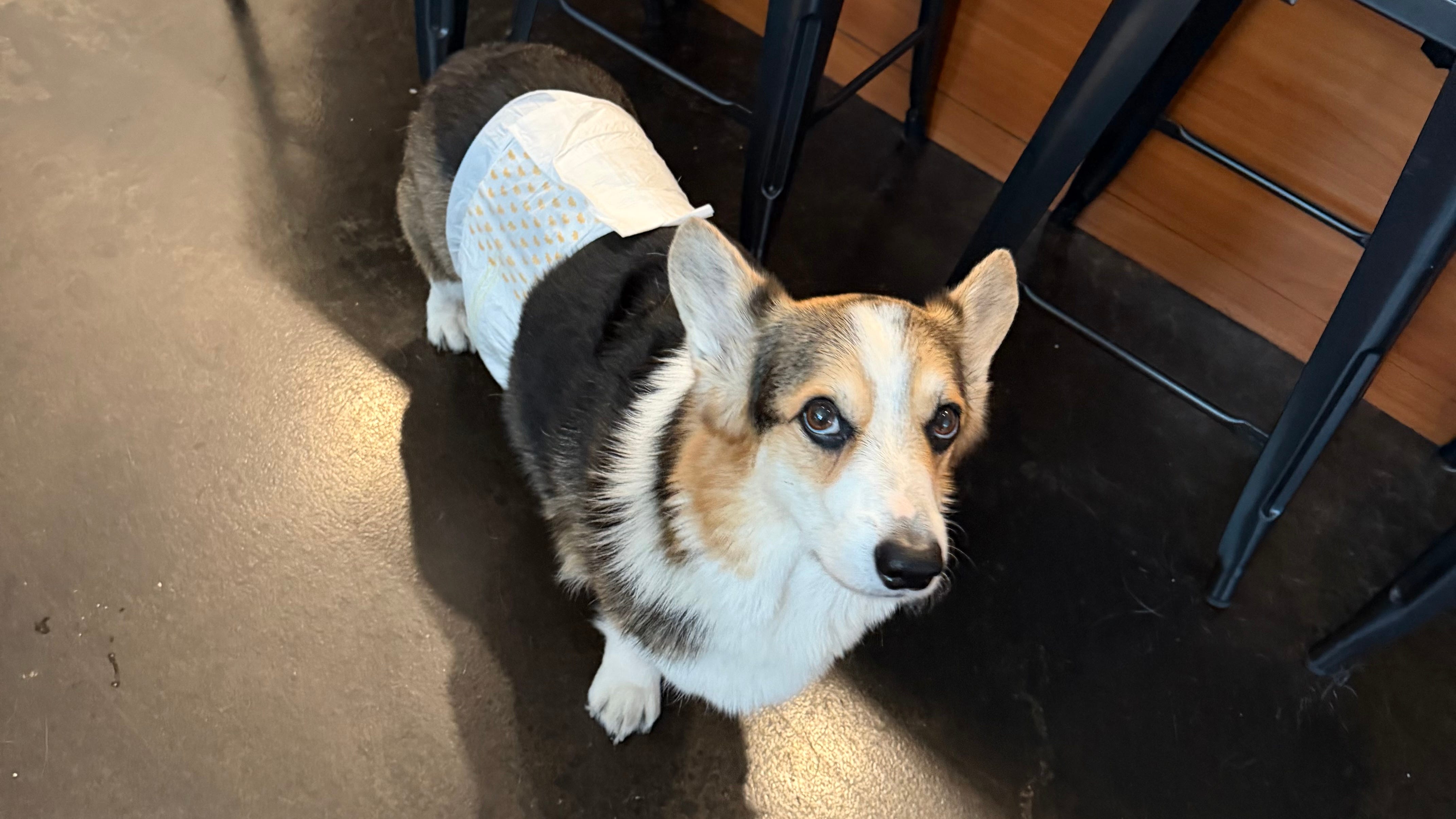
The urinary incontinence likely has two causes. One is the well-known side effect of increased water intake and urination: prednisone makes dogs thirsty, thirsty dogs drink more, and more water means more urgency. The other, in Graffiti’s case, may involve the positioning of his tumor relative to his bladder. Both are worth a conversation with your vet before you start.
Panting is also common in the first days and weeks, especially when awake and at rest. Graffiti did this intermittently in the early days, sitting up, panting lightly, settling after a few minutes. Making sure he was calm, cool, and in a comfortable position consistently helped. We keep the apartment around 68 to 69 degrees, and that has made a real difference.
Signs that warrant a call to your vet:
Significant GI distress: vomiting, dark or tarry stool, or loss of appetite after the first week. Prednisone can cause GI ulceration, particularly at higher doses or with prolonged use.
Behavioral changes that feel more like agitation or disorientation than simple energy.
Unusual lethargy, fever, or discharge. Prednisone can reduce the immune system’s ability to respond to infection at higher doses.
Gradual muscle loss, particularly visible along the back and hindquarters. Prednisone draws on muscle protein as a fuel source, which over weeks of use can lead to noticeable thinning along the spine or decreased strength and endurance in rising. Ensuring adequate protein in the diet can help offset this.
Changes in breathing that do not resolve, either sustained elevation in respiratory rate at rest, or new sounds like stridor or wet breathing.
So far, as of the date of this writing, Graffiti has none of these. He is eating well. He is engaged. His breathing, outside of that one significant night on March 8th, has been notably better since starting prednisone. His energy has settled from the initial burst into something steadier: a dog who is present, who perks up when his name is said, who is very interested in treats, who is fully here.
What about during or after a bleed?
One question I have seen asked frequently, and one I wanted to look into carefully before writing this: is it safe to be on prednisone during or after a bleed event?
What the research actually shows surprised me. Prednisone does not appear to worsen internal bleeding in hemangiosarcoma dogs. In fact, studies have found that prednisone administration in dogs promotes a hypercoagulable state, meaning the blood’s tendency toward clotting increases rather than decreases.
And I will be honest: reading that made the question of why no doctor before hospice mentioned this medication even harder for me to sit with. If prednisone can reduce inflammation and support the body’s clotting response, that seems like something every HSA family should know about early. I am not a veterinarian and I am not claiming to understand every clinical consideration. But I keep returning to it.
The risk to monitor for separately is GI ulceration, particularly at higher doses or when combined with NSAIDs.¹ During an active bleed, your clotting support tools, Yunnan Baiyao and aminocaproic acid (ACA), remain the immediate priority. That has not changed. But continuing prednisone through a bleed event, or having it already established in your care plan before one occurs, does not appear to pose an added risk based on what is currently understood.
Where prednisone seems most valuable in the bleed context is what comes after. Once a bleed has stabilized, the body enters an inflammatory period as it works to reabsorb blood from spaces it was not meant to be. That is where breathing becomes labored, where the nose gets noisy, where a dog can seem to be recovering outwardly while his body is still working very hard internally.
That post-bleed inflammatory burden is exactly what prednisone’s anti-inflammatory properties are designed to address.
After Graffiti’s February 18 bleed, he recovered, but the recovery was harder than I wanted it to be. I wonder now, having seen what prednisone has done for his breathing since March 3rd, whether that period could have been eased.
I believe it could have been.
That is a conversation worth having with your team before you face a bleed event, not during it, so that you already know what role prednisone should play in what comes after.
Where we are right now
Nine days in, I can say this: we are in the best stretch we have had since before his most recent bleed. His lungs have been through more since then. He does not trot on walks the way he once did. That toll is real and I do not want to minimize it. But prednisone seems to have hastened what recovery was still possible, lifting him back toward himself faster than he was managing on his own. Graffiti’s appetite is good. His comfort level is good. He is moving through his days with an ease that was not there before. I still count his breaths. I still sit with the phone timer. I still watch. But since we started on March 3rd, there have been no hard nights. The elevated breathing on March 8th was alarming in the moment but resolved on its own, and our hospice team’s read is that it was the medication adjusting, not a new bleed.
And days, real days, that feel like his.
Every time we are in the kitchen now, he is in the drop zone. Positioned and waiting, exactly the way he always used to be. Before this, it was maybe fifty-fifty. Now, since starting the prednisone, it is almost always. That is huge.
I feel, genuinely, that this medication is giving us more time with him. Not just more time, quality time. Days that still belong to him.
And this is not just our experience. When I shared on Facebook that we had started prednisone, many people responded with their own stories. Across a range of diagnoses and circumstances, the theme was consistent: a visible, rapid improvement in quality of life. That collective weight of experience matters, and it is part of why I am writing this.
Prednisone belongs on the list of things I wish had been part of our conversation earlier, alongside I’m-Yunity, a real conversation about the role of clotting support, and the anti-nausea medication that hospice paired with it, which has been significant in its own right. All of it. The careful recalibration of what comfort-focused care actually looks like in practice. The gap between what families are told and what families need to know is real. I do not fully understand why it exists. What I can do is keep writing.
If you are reading this somewhere in the middle of this, just diagnosed, recently through a bleed, somewhere in the long uncertain stretch, please bring this medication up with your care team. Bring this post if it helps. Ask: is this appropriate for where we are right now, and what would it be doing specifically for my dog’s body?
You deserve a real answer to that question.
That is what this space is for.
If this was useful to you, please share it with someone who needs it. There is no algorithm at work here. This space travels the way it always has, because someone cared enough to pass it along.
For now, we are here. Watching his breathing. Counting his blessings. Taking each good morning as the gift it is.
With Lub,
Momma Serbant
Your question is valid. Pred is a common medication given for many inflammatory issues, including palliative care. I wasn’t sure what he was on otherwise I would have mentioned it. The side effects are always a concern but keeping him comfortable in a palliative setting is the priority now. I just moved from the suburbs of Denver several months after being there for 3 years. I had two dogs when we moved to Colorado and I came back to Chicago with neither of them. Yes, they weren’t young but they didn’t have any medical diagnosis before we moved. While the veterinarians at a couple of locations we saw were nice, I was not impressed by the care as a whole. It was heartbreaking after coming from an area with access to amazing care. I am so happy you have palliative care supporting Gdog and you guys.
A lot to digest and understand, but you are an amazing parent (parents). I am lost for words, but my heart is there for you. Keep strong (I know you do). May each minute, hour, day continue to be a good day with hope and happiness. Thank you for sharing your knowledge.